 Etherfi
 connects staking and DeFi vaults to spending
Etherfi combines Ethereum liquid staking, automated DeFi vaults and Cash card payments backed by eligible crypto balances. Staking gives holders transferable tokens that represent pooled ETH. Liquid allocates deposits across managed strategies. Cash uses Direct Pay to spend supported balances or Borrow mode to fund purchases against collateral. These products can connect earning and spending, although asset eligibility, interest charges and regional access vary by service. The account also supports swaps and eligible bank transfers.
Key takeaway: Yield-bearing collateral can still be liquidated if falling asset values or accumulating debt push the loan to its liquidation threshold.
Cash connects card purchases to eligible balances
Cash supports payments through Visa, with Direct Pay and Borrow mode determining which balance funds a purchase. Virtual and physical cards connect to the account, subject to card eligibility and availability.
Direct Pay draws from spendable assets
Direct Pay deducts purchases from supported stablecoin and similar balances. A balance that appears in the account is spendable only if the payment mode supports that asset. This mode avoids creating a loan through each card purchase. The eligible spend balance, account limits and card limits govern the available spending capacity.
Borrow mode creates a collateral-backed debt
Borrow mode funds purchases by borrowing against eligible collateral. Each purchase adds to the outstanding loan, and interest accrues until repayment. Qualifying collateral can continue earning yield while backing the loan. The account retains exposure to the collateral's price as the borrowing balance grows.
An account can use Direct Pay for card spending and enable manual borrowing separately.
eETH and weETH carry Ethereum staking exposure
The staking pool accepts ETH and represents the pooled position through eETH or its wrapped form, weETH. Both relate to the same underlying staking pool, with different reward-accounting formats. Holders can request redemption for ETH; completion depends on protocol liquidity, Ethereum validator withdrawals and network conditions.
eETH adjusts the token balance
eETH is a rebasing token, so updates to pooled staking value can change the holder's displayed balance. The pool accounts for validator rewards and applicable penalties. Holding the token gives exposure to that pool without requiring its holder to operate a validator. The holder can transfer the tokenized position while the pool continues operating validators.
weETH keeps staking accrual in its conversion rate
weETH wraps eETH into a non-rebasing token. Staking reward accrual alone does not increase the number of weETH units held. Each unit represents an amount of eETH determined by the pool's share rate. Wrapping therefore changes the accounting format while preserving exposure to the same pool.
Compatible DeFi integrations add another use
Supported integrations can accept weETH as collateral, including Cash. The underlying staking exposure continues while the token participates in a compatible integration. That integration introduces its own contracts and collateral rules. A staking token's transferability does not establish universal support across lending markets or payment modes.
The protocol began winding down EigenLayer restaking
eETH and weETH accrue Ethereum staking rewards. Additional restaking requires a separate opt-in position, such as weETHs, with its own rewards and risks.
Restaking extended Ethereum validator-backed capital to additional services through EigenLayer. The staking architecture used EigenPod withdrawal credentials for that relationship. This was a protocol-level allocation beneath the staking tokens, separate from depositing those tokens into a managed DeFi vault. Ethereum staking and an additional restaking allocation serve different security commitments.
In August 2026, less than 1% of protocol assets remained restaked through EigenLayer. The same update set exit targets: remaining restaked assets by Q3 2026 and EigenPod withdrawal credentials by Q4 2026. Ethereum validator penalties and staking-contract vulnerabilities remain relevant to the continuing staking product.
Liquid manages strategies beyond the staking pool
Liquid places deposits into automated DeFi strategy vaults that rebalance and compound rewards. Its managed allocations add a separate layer of protocol exposure beyond simply holding a staking token.
Each vault has its own asset mandate
The available vault lineup includes ETH Yield, BTC Yield and USD Yield. Their supported deposit assets differ: ETH Yield accepts WETH and weETH, BTC Yield accepts eBTC and USD Yield accepts USDC. These are separate vault mandates, with different underlying exposures. A deposit asset's eligibility for one vault does not establish eligibility for another vault or for Direct Pay spending.
Allocations explain the source of yield
The Breakdown view shows positions, protocol exposure and network allocations. A vault's headline annual percentage yield, or APY, blends its strategies' yields. Protocol exposure percentages can exceed 100% because a strategy may involve multiple protocols. The figures describe protocol exposure; the network view shows capital allocations. Some strategies use leverage, adding liquidation exposure within the vault itself.
Withdrawal liquidity also depends on the deployed strategies. A vault may need time to release assets, and a withdrawal can enter a queue. A liquid staking token and a managed vault share therefore have different exit conditions, even when both ultimately represent ETH-related exposure.
What determines borrowing power for Cash?
Borrowing power depends on the assets that qualify as collateral, their loan-to-value limits and debt that is already outstanding. Equal portfolio values can support different loan sizes when the collateral composition differs. Loan-to-value, or LTV, expresses debt relative to collateral value; loans must remain over-collateralized. The account shows available borrowing capacity and the applicable liquidation level. Collateral can be liquidated when a loan reaches its applicable liquidation threshold. Falling collateral prices or increasing debt can raise LTV without another card purchase. Available-to-borrow figures describe additional borrowing capacity, not the total value of the assets held.
A loan can also reserve part of the balance to maintain the required collateral coverage. That leaves less available for spending or withdrawals than the headline account balance suggests. Repayment or additional qualifying collateral can improve the position's coverage; moving collateral out can reduce it.
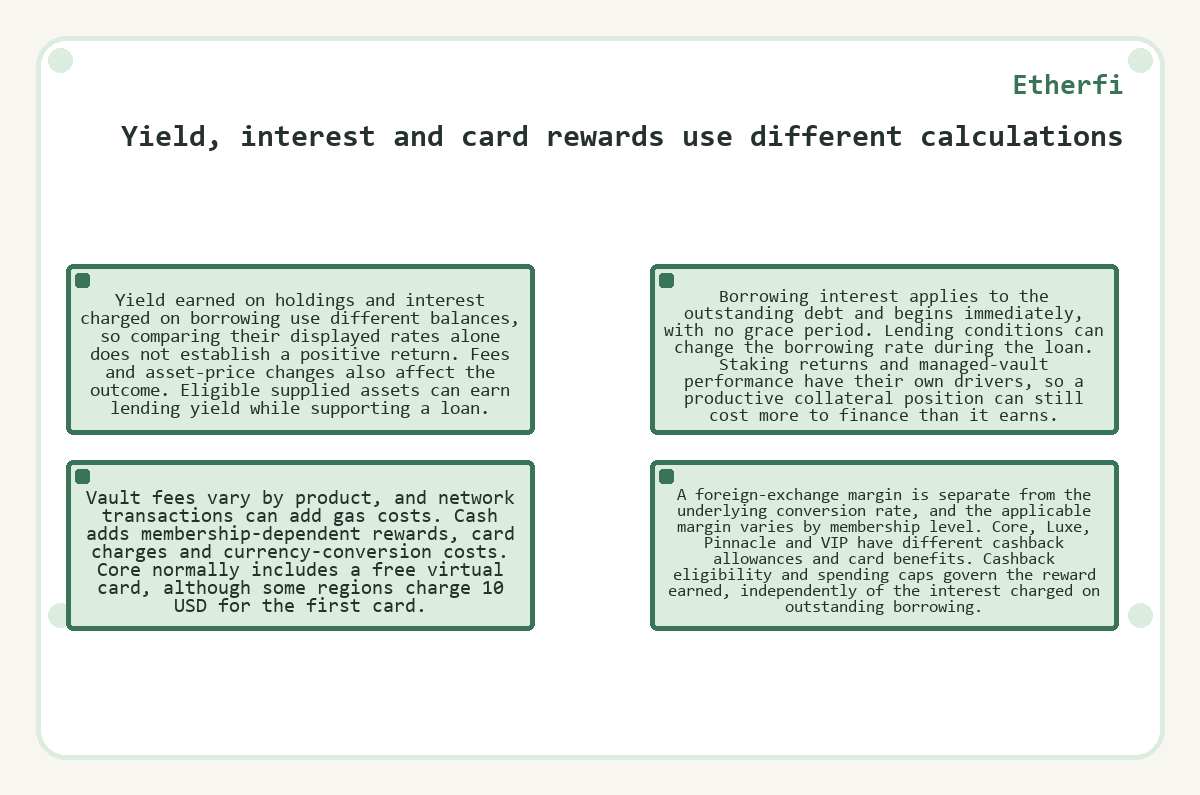
Yield, interest and card rewards use different calculations
Yield earned on holdings and interest charged on borrowing use different balances, so comparing their displayed rates alone does not establish a positive return. Fees and asset-price changes also affect the outcome.
Eligible supplied assets can earn lending yield while supporting a loan. Borrowing interest applies to the outstanding debt and begins immediately, with no grace period. Lending conditions can change the borrowing rate during the loan. Staking returns and managed-vault performance have their own drivers, so a productive collateral position can still cost more to finance than it earns.
Vault fees vary by product, and network transactions can add gas costs. Cash adds membership-dependent rewards, card charges and currency-conversion costs. Core normally includes a free virtual card, although some regions charge 10 USD for the first card. A foreign-exchange margin is separate from the underlying conversion rate, and the applicable margin varies by membership level.
Core, Luxe, Pinnacle and VIP have different cashback allowances and card benefits. Cashback eligibility and spending caps govern the reward earned, independently of the interest charged on outstanding borrowing.
Account control and product eligibility remain separate
Cash card access requires successful know your customer verification, or KYC, in an eligible jurisdiction. The account is non-custodial, while card access also involves an issuer and payment-network requirements. Connecting a wallet does not establish eligibility for every account feature.
Liquid's August 2026 access rules exclude users in the United States, Canada and the United Kingdom. Its availability uses the account's country, with IP-based location detection when that country cannot be determined. Card access, vault access and bank-transfer availability have their own conditions. A supported card jurisdiction does not automatically make a managed vault available there.
Non-custodial control leaves responsibility for wallet authentication and credentials with the holder. The account's smart contracts and the protocols that receive deposited assets remain part of the security exposure. Identity verification for a card also means that non-custodial access does not imply anonymous use of the payment service.
Swaps and bank transfers extend the account's uses
The account supports swaps between eligible blockchain tokens, including crypto assets and tokenized stocks and metals. Trade obtains competing quotations through underlying DeFi providers and presents a quote for confirmation. Available assets and trading access remain subject to regional and asset-level restrictions.
xStocks are tokenized representations that track corresponding stocks or exchange-traded funds. Regulated custodians hold their underlying assets through the issuer's structure. Holding such a token introduces an issuer relationship that differs from holding a token representing the Ethereum staking pool. Market liquidity, price impact and the execution quote affect the amount received in a swap.
Bank transfers provide eligible fiat funding and withdrawal routes according to currency and account eligibility. Each method has its own supported transfer direction, fees and processing conditions. Bank processing and compliance review can affect arrival time.
ETHFI governance, membership and product choices
ETHFI supports participation in governance, including decisions about the treasury, token utility and development. It has a different purpose from eETH and weETH, which represent staking-pool exposure. Staking ETHFI also supports membership benefits under separate qualifying rules.
Membership levels affect benefits and fees, while funding and collateral rules determine how Cash draws from the account.
- Use Direct Pay with assets that qualify as spendable balances.
- Review the collateral's LTV limit and liquidation threshold before Borrow mode spending.
- Select a Liquid vault by its asset mandate, allocations and regional eligibility.
- Distinguish staking redemption from managed-vault withdrawal conditions.
- Include strategy fees, card charges and borrowing interest in the combined cost.
What readers ask about Etherfi
-
Can Cash be used with Apple Pay and Google Pay?
- Cash supports Apple Pay and Google Pay for compatible card payments. The card still needs to be issued and activated for an eligible account. Adding it to a mobile wallet does not change its funding mode, borrowing terms or applicable spending limits.
-
What happens to a refund for a Borrow mode purchase?
- A Borrow mode refund credits the account's main balance and does not automatically reduce the outstanding loan. Repayment is a separate action. The borrowed balance continues accruing interest until it is repaid, even when the merchant has already returned the purchase funds.
-
Is the delivery address editable after a physical Cash card order?
- The shipping details cannot be changed after the physical card order is submitted. The delivery address is separate from the billing address, so the correct destination must be entered when ordering. Physical-card delivery also depends on whether the destination is supported.
-
Why do cash-like purchases have separate Cash card limits?
- Some cash-like purchases have merchant-category limits that apply separately from the account's standard spending capacity. The limit follows the merchant's classification and applies per card over the specified period. A sufficient balance therefore does not ensure that every merchant category permits the same purchase amount.
-
Are older KING rewards still claimable?
- Previously earned KING rewards remain claimable or unwrappable, and the legacy claims have no deadline. New KING issuance has ended. The legacy replacement mechanism reflected restaking rewards in the pool value represented by eETH and weETH. Current eETH and weETH accrue Ethereum staking rewards; additional restaking requires a separate opt-in product.
-
Does holding xStocks produce cash dividend payments?
- xStocks reflect dividends through reinvestment into additional underlying units, net of applicable taxes. Their rebasing mechanism also adjusts token balances for stock splits and reverse splits. These corporate actions normally require no manual action from holders, and dividend value does not arrive as a separate cash payment.
-
Where can I download proof of bank account ownership?
- After you complete identity verification (KYC), the web app provides a Proof of Ownership letter through Documents & Statements. The letter confirms ownership of the Etherfi account and can include details of an eligible virtual bank account that you select. Whether an external bank accepts it depends on that bank's document requirements.